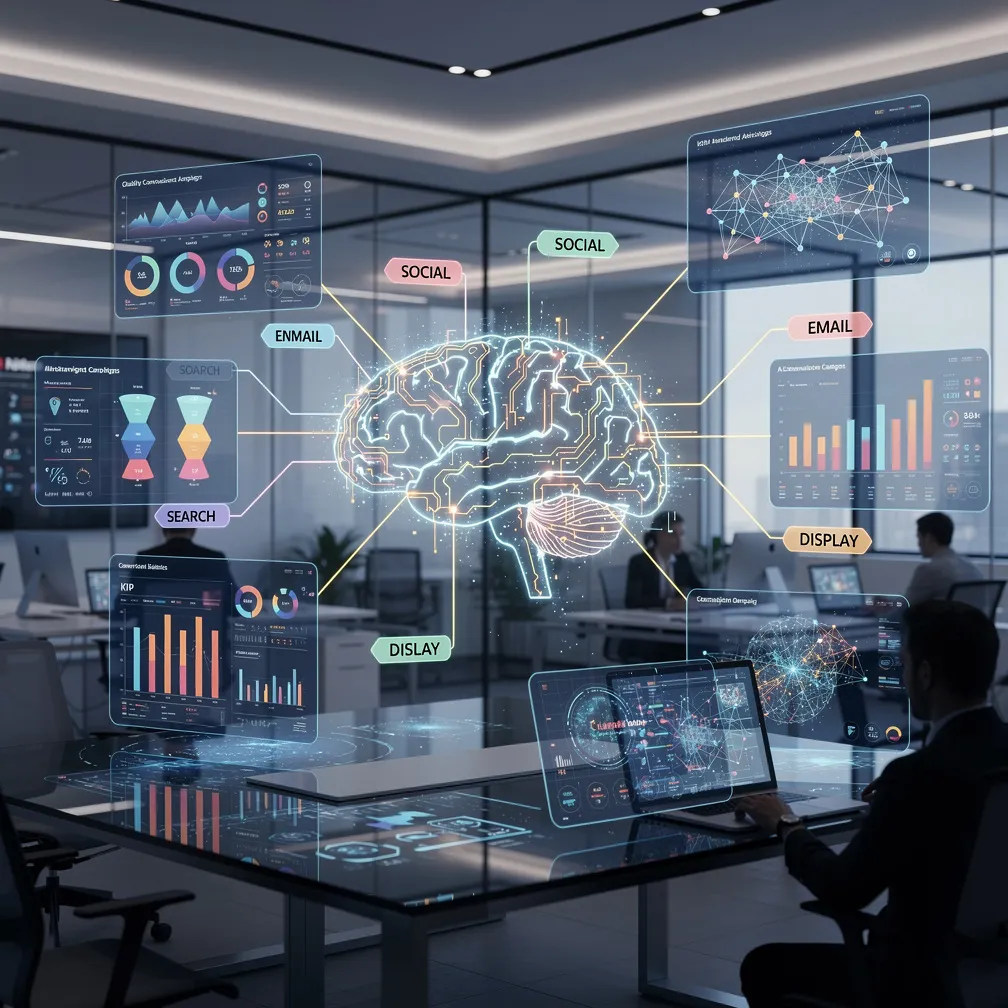
Marketing directors face an uncomfortable truth: the intuition-based strategies that worked five years ago now leave money on the table. While competitors extract actionable insights from every customer interaction, businesses relying on traditional approaches struggle to justify their marketing spend or predict which campaigns will actually drive revenue.
The shift toward data-driven digital marketing powered by artificial intelligence isn't just another trend — it's a fundamental restructuring of how successful businesses approach customer acquisition and retention. For mid-market companies especially, this transition represents both an urgent challenge and an unprecedented opportunity to compete with enterprise-level sophistication at a fraction of the historical cost.
From Intuition to Intelligence: The Marketing Evolution
Traditional marketing operated on a simple premise: experienced marketers made educated guesses about audience preferences, creative messaging, and channel selection, then waited weeks or months to evaluate results. This intuition-based approach created significant problems for growing businesses.
The fundamental limitation wasn't lack of talent — it was lack of visibility. Marketing teams made decisions in partial darkness, unable to see which specific actions drove conversions, which audience segments responded to particular messages, or how different channels influenced each other throughout the customer journey.
Data-driven digital marketing fundamentally changes this dynamic by making every marketing decision answerable to measurable evidence. Rather than relying on assumptions about what might work, modern marketing teams can test hypotheses, measure outcomes, and continuously optimize based on actual customer behavior. The difference isn't incremental — it's transformational.
What Data-Driven Digital Marketing Actually Means in 2026
Data-driven digital marketing refers to the practice of making strategic and tactical marketing decisions based on quantitative analysis of audience behavior, campaign performance, and market conditions rather than intuition or conventional wisdom.
In practical terms, this means modern marketing operations collect data from every customer touchpoint — website visits, email interactions, social media engagement, purchase behavior, and support conversations — then analyze these signals to understand what actually influences customer decisions.
The 2026 version of data-driven marketing differs significantly from earlier iterations in three critical ways:
- Real-time responsiveness: Marketing systems now adjust campaigns instantly based on performance data rather than waiting for weekly or monthly reviews
- Predictive capability: Advanced analytics forecast future customer behavior and campaign outcomes before resources are committed
- Cross-channel intelligence: Integrated platforms track customer journeys across multiple touchpoints to understand true attribution rather than crediting only the last click
The evolution from basic marketing analytics to comprehensive data-driven strategy represents a maturation of both technology and methodology. Today's approach doesn't just measure what happened — it predicts what will happen and prescribes optimal actions.
The Role of AI in Making Data-Driven Marketing Practical
AI-powered marketing solves the central challenge that prevented many mid-market businesses from fully embracing data-driven approaches: the overwhelming complexity of analyzing massive datasets and translating insights into action quickly enough to matter.
Human analysts can identify patterns in hundreds or thousands of data points. AI systems routinely process millions of signals simultaneously, detecting subtle correlations and emerging trends that would be impossible to spot manually. More importantly, AI doesn't just analyze — it acts.
Modern AI marketing tools automate the entire cycle from data collection through insight generation to campaign optimization. A marketing director no longer needs a team of data scientists to understand which email subject lines perform best with different audience segments, or which ad creative variations drive the highest conversion rates among specific demographics.
The emergence of agentic AI marketing represents the latest evolution in this space. Unlike earlier AI tools that required constant human direction, agentic AI systems operate with greater autonomy — setting their own sub-goals, testing hypotheses, and optimizing campaigns within parameters set by human strategists. This technology effectively gives mid-market companies access to a tireless optimization engine that continuously improves campaign performance.
For businesses evaluating their options, understanding the landscape of available tools is essential. Our comprehensive guide to AI-powered tools for digital marketing provides detailed comparisons of platforms suited for different business needs and budgets.
Key Capabilities AI Enables for Modern Marketers
The practical advantages of combining data-driven methodology with AI technology manifest across four critical marketing capabilities:
Predictive Analytics
AI-powered predictive analytics forecast customer behavior, campaign performance, and market trends before they fully materialize. Marketing teams can identify which leads are most likely to convert, which existing customers face the highest churn risk, and which product offerings will resonate with specific segments. This foresight enables proactive strategy rather than reactive adjustment.
Real-Time Optimization
Traditional A/B testing required weeks to reach statistical significance. Modern AI systems continuously optimize campaigns in real-time, automatically adjusting bid strategies, creative rotation, audience targeting, and message personalization based on immediate performance signals. A campaign that would have underperformed for days or weeks under manual management now self-corrects within hours.
Audience Intelligence
AI-driven audience analysis goes far beyond basic demographic segmentation. Advanced systems identify behavioral patterns, psychographic characteristics, and micro-segments that human analysts would never detect. This granular understanding enables hyper-personalized messaging that speaks directly to specific customer motivations and concerns.
Cross-Channel Attribution
Perhaps the most valuable capability AI brings to digital marketing strategy is accurate cross-channel attribution. By tracking customer journeys across paid search, social media, email, display advertising, and organic channels, AI models determine the true contribution of each touchpoint to conversion. This visibility eliminates the waste of over-investing in channels that get credit for conversions they didn't actually influence.
Why Mid-Market Businesses Are Adopting Fastest
Counterintuitively, mid-market companies are often adopting data-driven AI-powered marketing faster than their larger enterprise counterparts. Several factors explain this acceleration:
Agility advantage: Mid-market businesses can implement new technologies and processes without navigating the bureaucratic complexity that slows enterprise organizations. A marketing director at a mid-market company can often pilot new AI tools within weeks rather than months or quarters.
Competitive necessity: Mid-market companies face competition from both larger enterprises with bigger budgets and smaller startups with nothing to lose. Data-driven marketing with AI levels the playing field by maximizing the efficiency of every marketing dollar — a critical advantage when you can't simply outspend competitors.
Technology democratization: The cost of sophisticated AI marketing tools has dropped dramatically. Capabilities that required enterprise-level software investments five years ago are now available through accessible SaaS platforms with monthly subscription pricing that mid-market budgets can accommodate.
Measurable ROI pressure: Mid-market marketing directors face intense pressure to demonstrate return on investment. Unlike enterprise CMOs who might have more budget cushion, mid-market leaders need to justify every expenditure. Data-driven approaches provide the clear performance metrics and attribution that satisfy this requirement.
Talent constraints: Mid-market companies typically can't employ large specialized teams for every marketing function. AI-powered automation effectively multiplies the capability of smaller teams, allowing a lean marketing department to execute sophisticated multi-channel campaigns that would otherwise require significantly more headcount.
What to Look for in a Data-Driven Marketing Agency
For many mid-market businesses, partnering with a specialized data-driven marketing agency provides faster results than building internal capabilities from scratch. However, not all agencies claiming data-driven expertise deliver equivalent value.
When evaluating potential partners, prioritize these characteristics:
- Technical infrastructure: The agency should demonstrate proprietary or best-in-class analytics platforms, not just access to standard tools any marketer can purchase
- Transparent methodology: Look for agencies that clearly explain how they collect data, generate insights, and make optimization decisions rather than treating their process as a black box
- Industry-specific experience: Data-driven marketing requires understanding which metrics actually matter in your industry and what benchmarks represent good performance
- Integration capability: The agency should seamlessly connect with your existing CRM, marketing automation, and analytics systems rather than requiring you to adopt entirely new technology stacks
- Strategic consultation: The best agencies don't just execute campaigns — they help refine your overall digital marketing strategy based on data insights
- Proof of performance: Request case studies with specific, measurable results from companies similar to yours in size and industry
At Intellisea, our approach to data-driven digital marketing emphasizes transparency and measurable outcomes. We believe mid-market companies deserve the same sophisticated analytics and AI-powered optimization that enterprise organizations access, delivered with the responsiveness and cost-efficiency their budgets require.
Frequently Asked Questions
What is data-driven digital marketing?
Data-driven digital marketing is the practice of making marketing decisions based on quantitative analysis of customer behavior, campaign performance, and market data rather than intuition or assumptions. It involves collecting data from all customer touchpoints, analyzing patterns and trends, and using these insights to optimize targeting, messaging, channel selection, and budget allocation for measurable business outcomes.
How does AI improve data-driven marketing?
AI improves data-driven marketing by processing vast amounts of data faster and more accurately than human analysts, identifying patterns humans would miss, predicting future customer behavior, and automatically optimizing campaigns in real-time. AI eliminates the lag between data collection and action, enabling marketing systems to continuously improve performance without constant manual intervention.
What are the most important AI marketing tools for mid-market businesses?
The most important AI marketing tools for mid-market businesses include predictive analytics platforms that forecast customer behavior, automated bidding and optimization systems for paid advertising, AI-powered content personalization engines, intelligent email marketing platforms with send-time optimization, and cross-channel attribution tools that accurately measure campaign contribution across multiple touchpoints.
How long does it take for data-driven marketing to show results?
Most mid-market companies begin seeing measurable improvements within the first quarter of implementing data-driven AI-powered marketing. Quick wins like improved ad targeting and real-time bid optimization often appear within weeks, while deeper strategic advantages such as predictive audience modeling and cross-channel attribution typically mature over three to six months.
What results can businesses expect from data-driven marketing?
Businesses implementing data-driven marketing with AI typically see significant improvement in conversion rates, reduction in customer acquisition costs, increase in marketing ROI, and improved customer lifetime value through better retention and personalization. Results vary by industry and implementation quality, but most mid-market companies achieve measurable improvement within the first quarter of adoption.
The Competitive Imperative
The question facing mid-market marketing directors isn't whether to adopt data-driven digital marketing powered by AI — it's how quickly you can implement it before competitors gain an insurmountable advantage. Every month spent relying on intuition-based marketing is a month of wasted budget, missed opportunities, and customers acquired by more sophisticated competitors.
The technology has matured beyond the experimental phase. The cost has dropped to accessible levels. The competitive advantage is proven and measurable. For businesses serious about growth, the transition to data-driven, AI-powered marketing represents not just an upgrade to existing tactics but a fundamental reimagining of what marketing can achieve.