The phrase "AI marketing agency" gets thrown around a lot — but when you actually sit down to evaluate AI marketing agency services, the picture gets murky fast. Some agencies slap an AI label on the same manual processes they have been running for a decade. Others hand you a login to a dashboard full of AI tools and call it a service. Neither is what the market actually demands in 2026.
This guide breaks down what an AI digital marketing agency should deliver today, how autonomous AI agents are transforming every core service area, and the red flags that separate genuine AI-powered marketing agencies from the pretenders. Whether you are evaluating your first AI marketing partner or replacing one that underdelivered, this is the standard you should hold them to.
What AI Marketing Agency Services Look Like in 2026
The AI marketing landscape has shifted dramatically since 2024. Back then, "AI-powered" typically meant an agency used ChatGPT to draft blog outlines or ran automated bid adjustments in Google Ads. Those capabilities are now table stakes — the equivalent of saying you use email.
In 2026, a legitimate AI marketing agency delivers services through a fundamentally different operating model. The distinction is not which AI tools the agency uses. It is how AI participates in the work.
Three tiers now define the market:
Tier 1 — AI-Assisted. Human strategists do the work. AI tools speed up isolated tasks like keyword research, ad copywriting, or data visualization. Most traditional agencies sit here and simply market themselves as "AI-powered."
Tier 2 — AI-Augmented. AI handles recurring execution (scheduling posts, adjusting bids, flagging anomalies) while human teams own strategy and approvals. This is where the majority of self-described AI digital marketing agencies operate.
Tier 3 — Agentic AI. Autonomous AI agents plan, execute, monitor, and optimize across channels without waiting for a human to initiate each task. Human strategists set goals, review outcomes, and intervene for high-stakes decisions. The AI works around the clock — not just during business hours.
That third tier is where the category is heading. If the agency you are evaluating cannot articulate which tier they operate at — and show you evidence of it — that is your first signal to keep looking.
Core Services: How AI Transforms Each Discipline
An AI-powered marketing agency should cover the same service areas as any full-service partner: SEO, content, social media, paid media, and analytics. The difference is in how each service is delivered when agentic AI runs the execution layer.
Search Engine Optimization
Traditional SEO involves quarterly audits, manual keyword tracking, and spreadsheet-driven content calendars. An AI-driven approach flips the cadence from periodic to continuous.
Here is what that looks like in practice:
- Continuous technical auditing. Instead of a quarterly crawl, AI agents monitor crawl health, indexation status, Core Web Vitals, and schema validation on a rolling basis. Issues are flagged — and often resolved — before they compound into ranking drops.
- Real-time keyword intelligence. Agents track position changes daily, identify emerging keyword opportunities as search volume shifts, and recommend content updates or new pages based on competitive movement.
- Automated on-page optimization. Title tags, meta descriptions, internal linking structures, and heading hierarchies are analyzed and optimized at scale. For sites with hundreds of pages, this alone can save dozens of hours per month.
- Content gap analysis. AI compares your topical authority against competitors and identifies the exact clusters where additional content would strengthen your rankings — not as a one-time report, but as a continuously updated map.
The human strategist still owns the editorial direction, the brand voice, and the prioritization of which opportunities to pursue. But the research, monitoring, and technical execution happen faster and more thoroughly than any human team could manage alone.
Content Marketing
Content remains the backbone of organic growth, but the production model has evolved. AI marketing agency services in 2026 should include:
- Research-driven topic generation. AI agents analyze search trends, competitor publishing patterns, People Also Ask data, and your existing content performance to surface topics with the highest probability of ranking and converting.
- Draft generation with editorial oversight. AI produces first drafts at scale. Human editors shape voice, verify accuracy, add original insights, and ensure every piece reflects the brand. This is not "AI-generated content" — it is AI-accelerated content with human quality control.
- Performance-based content refresh. Agents identify underperforming pages and recommend specific updates — new sections, updated statistics, improved headings — to recapture declining rankings. This happens automatically, not when someone remembers to check.
- Multi-format repurposing. A single long-form article gets distilled into social posts, email snippets, video scripts, and infographic data points by AI, extending the ROI of every piece without additional creative hours.
The agencies still producing content the old way — a writer gets a brief, disappears for a week, submits a draft, revisions take another week — cannot match the velocity or data precision of an AI-driven content operation.
Social Media Management
Social media is where AI's pattern recognition delivers outsized returns. An AI marketing agency handling social should provide:
- Audience behavior modeling. AI identifies when your specific audience segments are most active, which content formats drive engagement for your industry, and how platform algorithm changes affect reach — then adjusts the publishing strategy accordingly.
- Automated content scheduling and adaptation. Posts are scheduled based on engagement prediction models, not arbitrary editorial calendars. If a topic is trending in your vertical, AI can flag the opportunity and draft a timely response.
- Sentiment monitoring. AI agents track brand mentions, competitor conversations, and industry sentiment shifts in real time, surfacing opportunities and risks before they fully develop.
- Performance optimization. Post-by-post engagement data feeds back into the publishing model, continuously refining what gets posted, when, and on which platforms.
Paid Media (PPC and Paid Social)
Paid media is arguably where AI marketing agency services deliver the most measurable impact. The feedback loop between spend and outcome is tight, data-rich, and perfectly suited to autonomous optimization.
What to expect from an AI-powered paid media operation:
- Dynamic bid management. AI agents adjust bids in real time based on conversion probability, time of day, device, geography, and dozens of other signals. This is not the same as enabling Google's automated bidding — it is an additional optimization layer that accounts for your specific business goals.
- Creative testing at scale. AI generates ad copy variations, tests them against each other, and reallocates budget toward winners automatically. The testing velocity of a well-run AI system can exceed what a human media buyer achieves in a quarter — in a single week.
- Audience expansion and refinement. Lookalike modeling, retargeting segment optimization, and cross-platform audience matching run continuously rather than during periodic campaign reviews.
- Budget reallocation. When one channel or campaign outperforms, AI shifts budget in real time rather than waiting for a weekly or monthly review meeting.
- Anomaly detection. Sudden cost spikes, click fraud patterns, or conversion drop-offs trigger immediate alerts and automated corrective action.
Analytics and Reporting
Data without context is noise. An AI digital marketing agency should transform analytics from a reporting function into a decision-making engine:
- Unified cross-channel dashboards. AI aggregates data from organic search, paid media, social, email, and CRM into a single view — not just for reporting, but for identifying cross-channel patterns human analysts would miss.
- Predictive forecasting. Based on historical data and current trajectory, AI models project traffic, conversion, and revenue outcomes weeks or months ahead, allowing proactive strategy adjustments.
- Automated insight generation. Instead of waiting for a monthly report, AI agents surface the most significant changes and opportunities as they happen. A ranking jump, a conversion rate shift, a competitor's new campaign — you know about it in hours, not weeks.
- Attribution modeling. Multi-touch attribution powered by AI provides a clearer picture of which channels and touchpoints actually drive revenue, replacing last-click guesswork with data-informed budget allocation.
How Intellisea's Agentic AI Platform Delivers These Services
Intellisea operates at Tier 3 — the agentic AI model. Here is what that means in practice for clients.
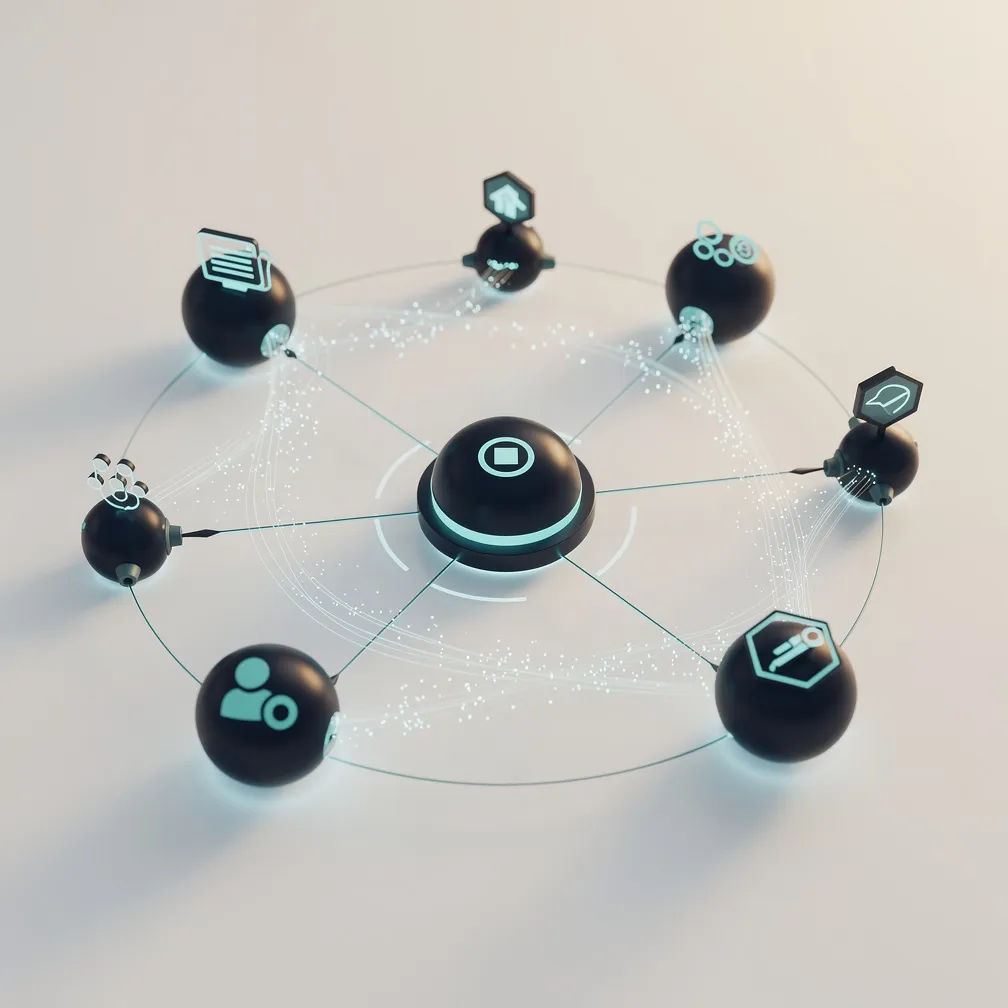
Intellisea deploys specialized AI agents for each marketing discipline: an SEO agent, a content agent, a paid media agent, a social agent, and an analytics agent. These agents do not wait for a human to assign tasks. They operate on goals.
Set a target — grow organic traffic by 30 percent, reduce cost per acquisition by 15 percent, publish four pieces of content per month targeting specific keyword clusters — and the agents begin executing. They research, plan, build, publish, monitor, and optimize. Human strategists review the work, approve high-impact decisions, and adjust the goals as business conditions change.
This is not a dashboard you log into. It is not a suite of tools you learn to use. It is a done-for-you service where autonomous agents handle the execution and human experts handle the judgment.
The practical benefits for clients:
- Speed. Tasks that take a traditional agency days — keyword research, technical audits, ad copy testing — happen in hours or minutes.
- Consistency. Agents do not forget to check rankings, miss a scheduled post, or let a campaign overspend over the weekend. They execute around the clock, every day.
- Scalability. Adding a new service area or expanding to a new market does not require hiring more people. The same agent infrastructure scales with the workload.
- Transparency. Every action an agent takes is logged and reviewable. You see exactly what happened, when, and why — not a summary slide in a monthly deck.
Intellisea is based in Dallas, TX, and serves clients nationally. The agentic AI model means geography does not limit responsiveness — the agents work in every time zone simultaneously.
Red Flags When Evaluating AI Marketing Agencies
Not every agency claiming AI capabilities actually delivers them. Here are the warning signs:
They cannot explain their AI model. If the answer to "How do you use AI?" is vague or amounts to "we use the latest tools," that is Tier 1 at best. Press for specifics: which tasks does AI execute autonomously, and which require human initiation?
They sell tools, not outcomes. An AI-powered marketing agency delivers results — rankings, traffic, conversions, revenue growth. If the pitch centers on platform access, dashboards, or "AI-generated reports," you are being sold software, not a service.
They have no human oversight layer. Pure automation without strategic review is reckless. AI agents are powerful executors, but they need human judgment for brand voice, ethical considerations, and high-stakes decisions. An agency that removes humans entirely is cutting the wrong corner.
They cannot show you the work. Ask to see examples of AI-executed campaigns, content produced through their AI workflow, or optimization logs. If everything is a black box, the "AI" may be more marketing than methodology.
Their pricing does not reflect the model. An agency running agentic AI should be more efficient than a traditional agency, which should show up in pricing or in the scope of work you receive for the investment. If prices are identical to a traditional agency but the deliverables are the same, the AI is probably cosmetic.
They do not mention agentic AI. In 2026, this is the dividing line. Agencies still framing their AI capability around tools and automation are a generation behind. The term "agentic" is not buzzword — it describes a specific operational model where AI agents act autonomously toward goals. If the agency has not adopted this framing, they likely have not adopted the model.
Frequently Asked Questions
What services do AI marketing agencies offer?
AI marketing agencies typically offer SEO, content marketing, paid media management, social media marketing, and analytics. The key difference from traditional agencies is how these services are delivered — through AI agents that automate research, execution, and optimization, with human strategists providing oversight and strategic direction.
How is AI used in digital marketing?
AI is used across nearly every marketing discipline. In SEO, it automates technical audits and keyword tracking. In content, it accelerates research and draft production. In paid media, it manages bids and tests creative in real time. In analytics, it surfaces insights and predicts future performance. The most advanced application is agentic AI, where autonomous agents execute entire marketing workflows around the clock.
What is the difference between AI tools and AI agencies?
AI tools are software platforms that require a human operator — someone has to log in, configure settings, and interpret results. An AI agency uses AI agents as part of a managed service. The agency handles strategy, execution, and optimization on your behalf. You get the results without needing to learn, manage, or operate the technology yourself.
How much do AI marketing agency services cost?
Pricing varies by scope, but AI-powered agencies often deliver more output per dollar than traditional agencies because autonomous agents handle high-volume execution tasks. Monthly retainers for a full-service AI marketing engagement typically start in the range of mid-four figures, depending on the number of channels, the competitive landscape, and the growth targets involved. The right question is not just cost — it is cost per outcome.
Ready to See What Agentic AI Can Do for Your Marketing?
If you are evaluating AI marketing agency services, start with a clear picture of where you stand today. Intellisea offers a free AI marketing audit that assesses your current organic visibility, paid media efficiency, content gaps, and competitive positioning — then maps out exactly where agentic AI would make the biggest impact.
No obligation. No sales pitch. Just a data-driven look at your marketing through the lens of what AI can actually do in 2026.
Request your free AI marketing audit today.